
When a storm comes through central Indiana, the phone starts ringing before the rain stops. Emergency work is different from scheduled work: the first job is making the property safe — getting weight off a roof, clearing a driveway, keeping people away from anything touching a line — and the second job is the cleanup. We separate those on purpose, so you are not paying storm rates for work that can wait until Tuesday.
Bushes: shape on the outside, green on the inside
Most people want a defined shape — a clean cube, a sphere, a hedge with a crisp line, sometimes something closer to an Edward Scissorhands sculpture. That is a craft, and we like doing it.
The way you get it is by pruning often and lightly. Frequent trims hold the outer shape and keep the core covered, so you never see into the middle of the plant. The mistake is cutting too hard in one go: take off too much and you expose the bare interior, and it takes a long time to fill back in.
The other mistake is waiting. Leave a bush too long and the inner branches die off, so the greenery lives only out at the tips. Now bringing it back under control — down below a window ledge, well clear of the gutters — means cutting into bare wood, and it looks rough for a season or more. Sometimes it does not come back at all.
That is the whole argument for a regular schedule: trimming a little and often costs less and looks better every single week than a rescue does.
On a technical removal, you are paying for the rigging
We had a maple growing at an angle over a detached garage with a fence on one side and a neighbor’s koi pond on the other — nowhere to drop anything. It came down piece by piece on ropes: hold-up and hold-back lines to control where the weight went, a swing rope to steer each piece away from the roof, and a side cut so it left the stem in the direction we wanted rather than the direction gravity wanted.
The part that does the real work is the hinge. We cut a Humboldt, and on the awkward ones an offset Humboldt — a deliberately uneven hinge that usually buys more control and more swing, and lets the piece clear into the drop zone or the lowering zone before the cut breaks all the way through. When a piece is too big to swing by hand, the pull comes from a truck or the ATV instead of a person. “Usually” is doing honest work in that sentence — wood is not uniform, and anyone who tells you a cut behaves the same every time has not done enough of them.
It took most of a day for a tree a wide-open lot would have given up in an hour. Nothing touched the garage, and the fish never knew we were there. That is what you are paying for on a technical removal: not the cutting, the rigging.
Deadwood and fungus
On healthy trees, the work is usually deadwood and fungus. Dead limbs are the ones that come down on their own schedule, so they come out first. Fungal growth at the base or in a crotch is worth a look before it becomes a decision — sometimes it is cosmetic, sometimes it means the tree has less structural wood left than it appears to. We will tell you which one we think it is, and we will tell you when a tree does not need to come down. Talking a customer out of a removal has never once cost us money in the long run.
Then the debris leaves
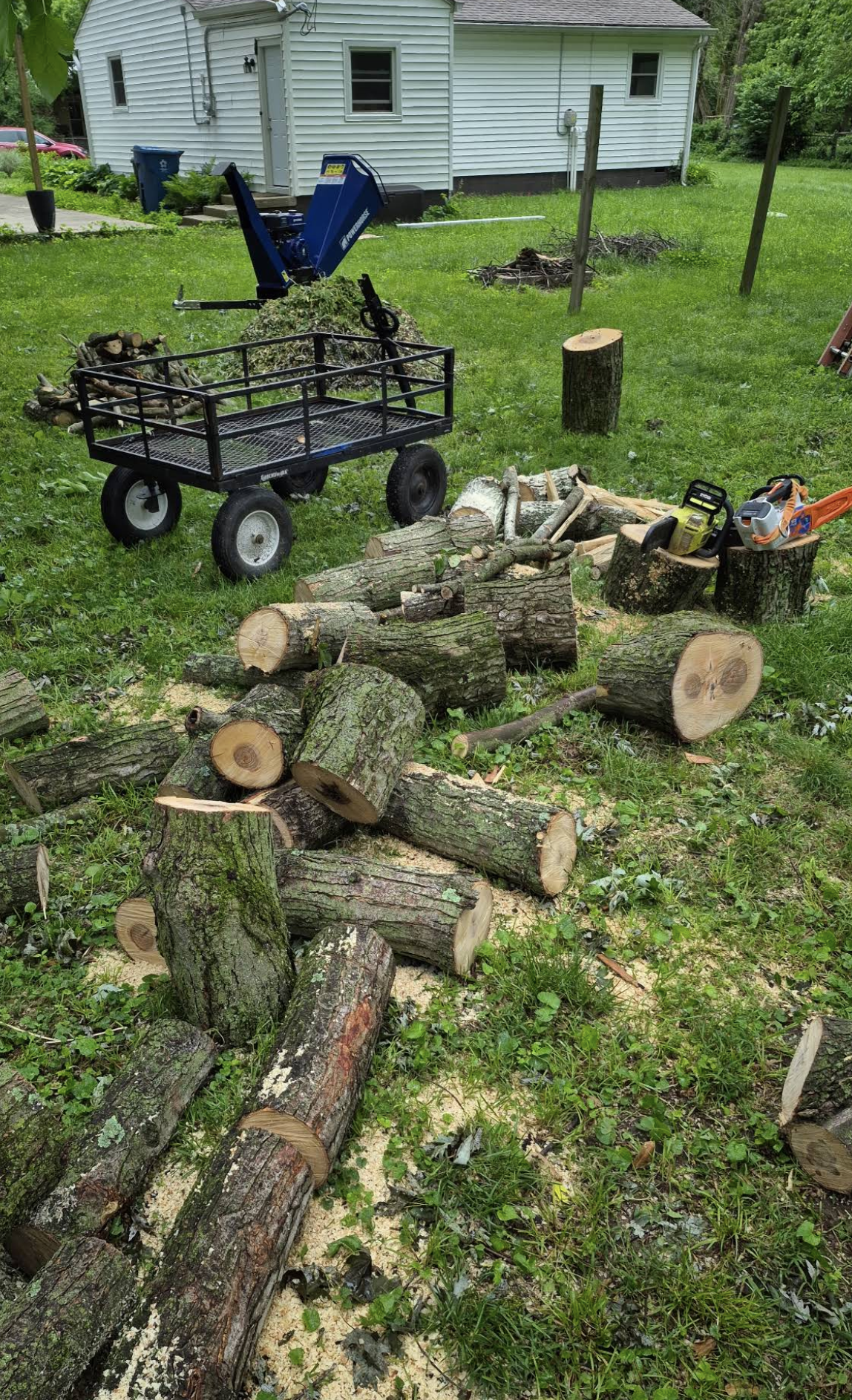
Brush gets chipped, logs get cut for firewood if you want them or hauled if you do not, and the beds get raked back out. We run quiet, low-emission equipment where it will do the job, keep the chipper away from the property line when we can, and stage the truck so your neighbors can still get down the street. You should not be able to tell we were there except for the thing that is no longer there.